

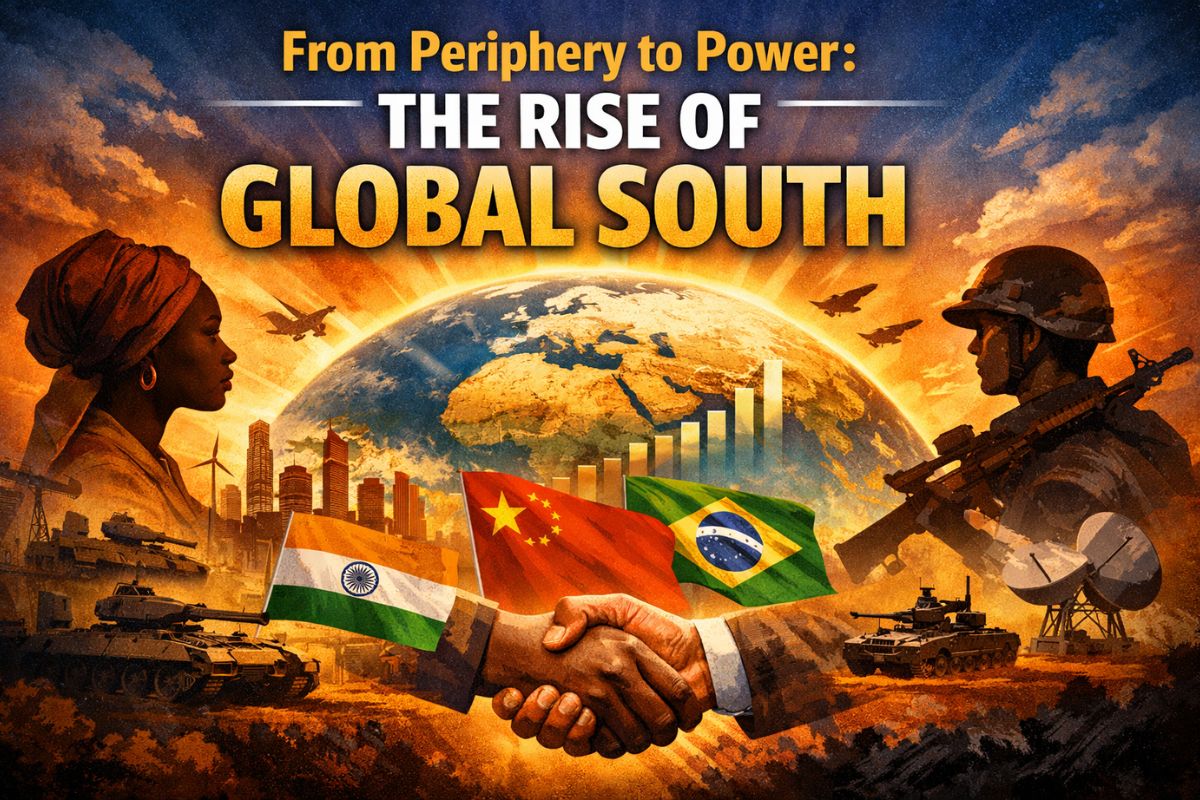
The Global South nations comprising of developing, less developed, or underdeveloped, nations primarily located in Africa, Asia, and Latin America sharing a common legacy of colonialism are becoming increasingly more assertive as there is economic weight shift from developed nations to developing nations with a greater demand for multipolar world supporting agendas for institutional push back and issue based diplomacy.
The rising economic dominance of Global South: The projections indicate that by 2030, three of the four largest economies will comprise Global South nations with China and India emerging as the key economic players.
The rising power of the Global South could be well understood in terms of the way expanded BRICS consisting of Brazil, China, Egypt, Ethiopia, India, Indonesia, Iran, Russia, South Africa, Saudi Arabia and the UAE has taken the centre stage becoming a credible rival to G7. The combined nominal GDP for the expanded BRICS+ group (including new members) was projected around $80.36 trillion for 2025, significantly outpacing the G7’s estimated $58.57 trillion, with BRICS+ also holding a larger share (around 40-42%) of the global economy by Purchasing Power Parity (PPP) in 2024-2025.
Now a shift is clearly visible as the economic dominance gradually shifts from the North Atlantic to Asia-Pacific region.
Amid volatility the Global South carving a niche for itself: One of the key challenges that Global South faces is under representation in global institutions such as UNSC, IMF and World Bank. To counter the dominance of Global North these nations are now taking steps to form parallel organizations which take care of their best interests.
Also Read:- India’s Middle East foreign policy and geopolitical interests
The New Development Bank and Asian Infrastructure Investment Bank headquartered in Shanghai and Beijing, China are respectively creating new avenues to challenge Western hegemony. Though World Bank is still way ahead in its lending portfolio but nevertheless a start has been made by the Global South nations to challenge the global institutions having the dominance from Global North
Strengthening Defence ties among each other: Also, geopolitics is seeing a transformation where Global South nations are showing less dependence on organizations such as NATO but promoting the defence partnership with the nations of Global South.
They are undertaking a wide ranging cooperation activities in defence and security ranging from Military training & capacity-building, Joint exercises, to Defence industrial cooperation and Peacekeeping collaboration.
Also Read:- Bangladesh-India Relations at Stake: Navigating through turmoil
If BRICS is playing a key role through Defence Minister’s Dialogues, Growing interest in defence-industrial cooperation then other Global South nations are also fostering cooperation among themselves. For example: ASEAN defence dialogues with South Asian partners, India taking steps to boost its defence exports to Southeast Asia, Africa, and Latin America apart from strengthening SAGAR initiative to reach out to the partners in Global South.
Multipolar World order: The Western dominance is fading as the nations of the Global South find space for playing its role in geopolitics. These nations now no longer show affination towards block-based alignment. They are very assertive, showing strategic autonomy.
In present terms the Global South is showing its leadership in every area where their interest is involved rather than following a blind ideology. Now their voices are being heard in every platform on the diverse and complex issues from climate finance, development funding, to technology access, food and energy security.
The 21st century belongs to the Global South and the rise of India and China on the global stage once again reassert this point. However there must be a caution that the ambition of Global South may not start another phase of cold war as the Developed nations are still reluctant to provide the right place to these nations. The Global South will have to create its own space with a shared responsibility of world peace and unity.








Leave a comment